Three‑Year Oxford Study to Explore Public Confidence in Democratic Institutions

The Centre for Democratic Resilience at the University of Oxford has launched a three-year study into examining how deliberation and participation affect long term political trust. In this context, long-term political trust refers to a sustained confidence in political institutions, representatives, and democratic processes, as opposed to short-term approval of individual decisions.

This investigation will create opportunity for a well-rounded understanding of the depth of public perception regarding politics and can inform future discussions surrounding Citizen’s Assemblies. The research will run from 1 September 2026 to 1 September 2029.

Debate Reopens on a Written British Constitution as Barnett Highlights Allen’s Earlier Work

Anthony Barnett’s article regarding the possibility of a British Constitution under Prime Minister Andy Burnham’s authority, and refers to work done by Graham Allen.

The article discusses the possibility of creating a written British constitution and having government undergo a decentralisation of power. It also recognises the potential issues that could arise in the presence of a constitution.

Graham Allen was the chair for the Select Committee on Political and Constitutional Reform where he oversaw the publication of a previous draft of a constitution by the House of Commons in 2014.

You can find the article by searching ‘Is Andy Burnham About to Create a British Constitution?” on Byline Times, or by clicking here.

THE GLOBAL SUMMIT FOR DEMOCRACY

On 19th March 2024, the Global Summit for Democracy met with Presidents and Prime Ministers from across the democratic world, online and in person in Seoul, South Korea. One of the sessions was led by the Deliberative Democracy and Citizens’ Assembly Cohort called “Achieving Public Trust: Deliberative Democracy in Practice.” You can view the contributions of the speakers, to hear how Citizens’ Assemblies are being taken forward, in the video below.

Read more

Letter to the Financial Times: Citizens’ assemblies are an underused political gift

Your editorial (“Biden’s domestic agenda is beginning to stall”, June 18) suggests the gridlock of representative democracy in the US needs to be overcome by appealing to what the polls repeatedly show is an electorate which is far less polarised than its representatives.

Democracies across the planet are now proving the new tools to make this happen.

A microcosm of a nation’s citizens — impartially selected and independently deliberating — could easily offer to the presidency and legislature a legitimate and public consensus on a key range of issues starting with police powers, voting rights and infrastructure spending.

These gifts of citizens’ assemblies would carry immense weight, meriting serious consideration from all elected representatives.

They could be used regularly by the US and other democracies including our own. Since winning the concept of one person one vote, it has been effective citizens’ engagement between elections which has been the missing piece in the evolution of our democracies.

The 1770s were an epoch-making decade for democracy. The 2020s can be a time for a quieter, but no less significant, step to help us win the battle between democracy and autocracy.

Graham Allen, Convenor of the Citizens’ Convention for UK Democracy; Chair of the Parliamentary Select Committee on Political and Constitutional Reform

CCUKD appears on Conservative Home and the Social Liberal Forum.

The Citizens’ Convention on UK Democracy has featured on both Conservative Home and the Social Liberal Forum. Convenor of the CCUKDemocracy, Graham Allen, explains why now is the time to renew our democratic system through a thorough and inclusive deliberative process with all-party support, and how the CCUKDemcracy aims to do just that.

You can read the Conservative article here, and the piece on the Social Liberal Forum here.

“Democracy is under threat, not least because it has failed to evolve. But the next era of democracy is taking shape - and a Citizens’ Convention on UK Democracy is the way to bring that new mode of democracy to these proud islands.”

Climate Assembly UK Final Report: the path to net zero

Climate Assembly UK, the first UK-wide citizens’ assembly on climate change, has published its final report. The report contains over 50 coherent, achievable recommendations for how the UK should go about reaching its legally binding net zero emissions by 2050 target. Produced by a representative cross-section of society, the report gives a unique insight into the public’s preferences, priorities and values when it comes to tackling climate change.

The Business Energy and Industrial Strategy Secretary, Alok Sharma, spoke at the launch of the report. He acknowledged the value of working with a dedicated group of citizens on the issue and said its recommendations would be carefully examined and inform the government’s approach.

In leading to such a comprehensive and practical series of proposals, the experience of Climate Assembly UK adds to the evidence for the efficacy and value of public deliberation and citizens’ assemblies.

The inspiring report launch, which featured participants, the Chairs of the commissioning select committees and the BEIS Secretary, is worth catching up on in full online. There is also a shorter, executive summary of the report that can be found here.

Methods for involving citizens in decision-making

Involve have published a collection of 54 participatory methods and tools on their website. There is detailed info on each approach, including its costs, level of participation, what they should be used for and their respective strengths and weaknesses.

A really useful resource for any organisation looking to engage meaningfully with the public.

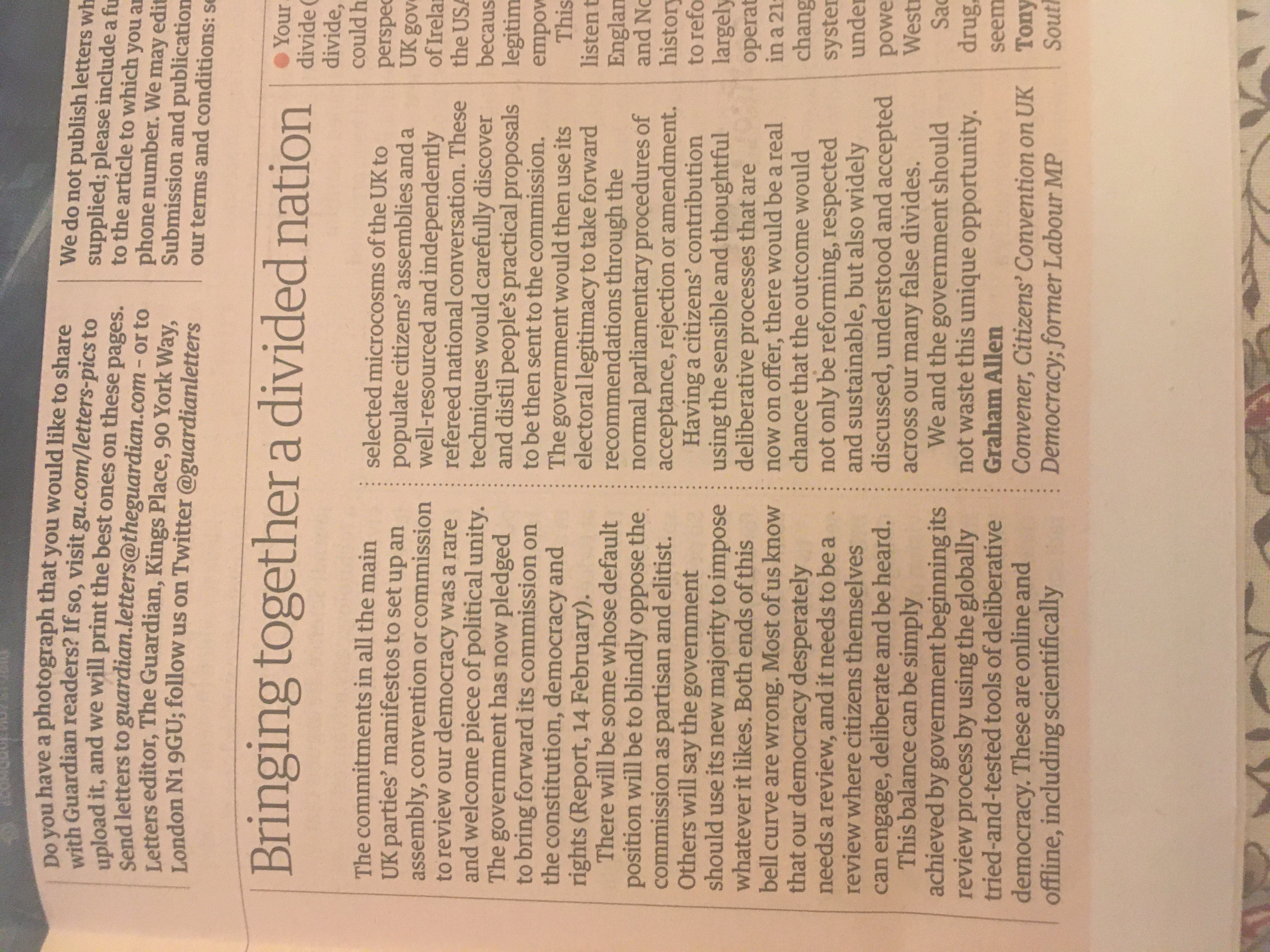
Bringing together a divided nation

We wrote to the Guardian in 2020 calling on the government to involve citizens and use deliberative democracy in their proposed Constitution, Democracy and Rights Commission.

Guardian letters

The commitments in all the main UK parties' manifestos to set up an assembly, convention or commission to review our democracy was a rare and welcome piece of political unity. The government has now pledged to bring forward its commission on the constitution, democracy and rights (Report, 14 February).

There will be some whose default position will be to blindly oppose the commission as partisan and elitist. Others will say the government should use its new majority to impose whatever it likes. Both ends of this bell curve are wrong. Most of us know that our democracy desperately needs a review, and it needs to be a review where citizens themselves can engage, deliberate and be heard.

This balance can be simply achieved by government beginning its review process by using the globally tried-and-tested tools of deliberative democracy. These are online and offline, including scientifically-selected microcosms of the UK to populate citizens' assemblies and a well-resourced and independently refereed national conversation. These techniques would carefully discover and distil people's practical proposals to be then sent to the commission. The government would then use its electoral legitimacy to take forward recommendations through the normal parliamentary procedures of acceptance, rejection or amendment.

Having a citizens’ contribution using the sensible and thoughtful deliberative processes that are now on offer, there would be a real chance that the outcome would not only be reforming, respected and sustainable, but also widely discussed, understood and accepted across our many false divides.

We and the government should not waste this unique opportunity.

Graham Allen, Convener of the CCUKD

Could you help shape the future of UK democracy?

The BBC reported on the Convention. The article covers the plan for the process, what will be discussed and who can get involved. It also gives some examples of deliberative democracy in action from around the world.

We are trying to renew British politics and strike a blow for democracy — now we need your help

Innovation in Democracy Programme Resources

The Innovation in Democracy Programme (IiDP) have published an exciting new set of resources from the project, which completed its activities last year.

IiDP was commissioned by the Department for Culture, Media and Sport and the Ministry of Housing, Communities and Local Government to trial deliberative democratic methods as a way of involving citizens in local government decision-making. It supported three local authorities (Cambridge, Test Valley and Dudley) to involve residents in tackling a local issue through a citizens’ assembly. The programme was run in partnership with Involve, DemSoc, the RSA and MySociety and led by CCUKD Advisory Board member Miriam Levin at DCMS.

They have produced a handbook for running local citizens’ assemblies based on insights from the programme alongside a case studies document with responses from the council staff that led each assembly. There is also an independent evaluation document and a brilliant short film documenting the experience of participants in the assemblies. All in all, an important suite of new resources that will be extremely helpful for practitioners and will hopefully encourage more local authorities to run deliberative processes in the future.